
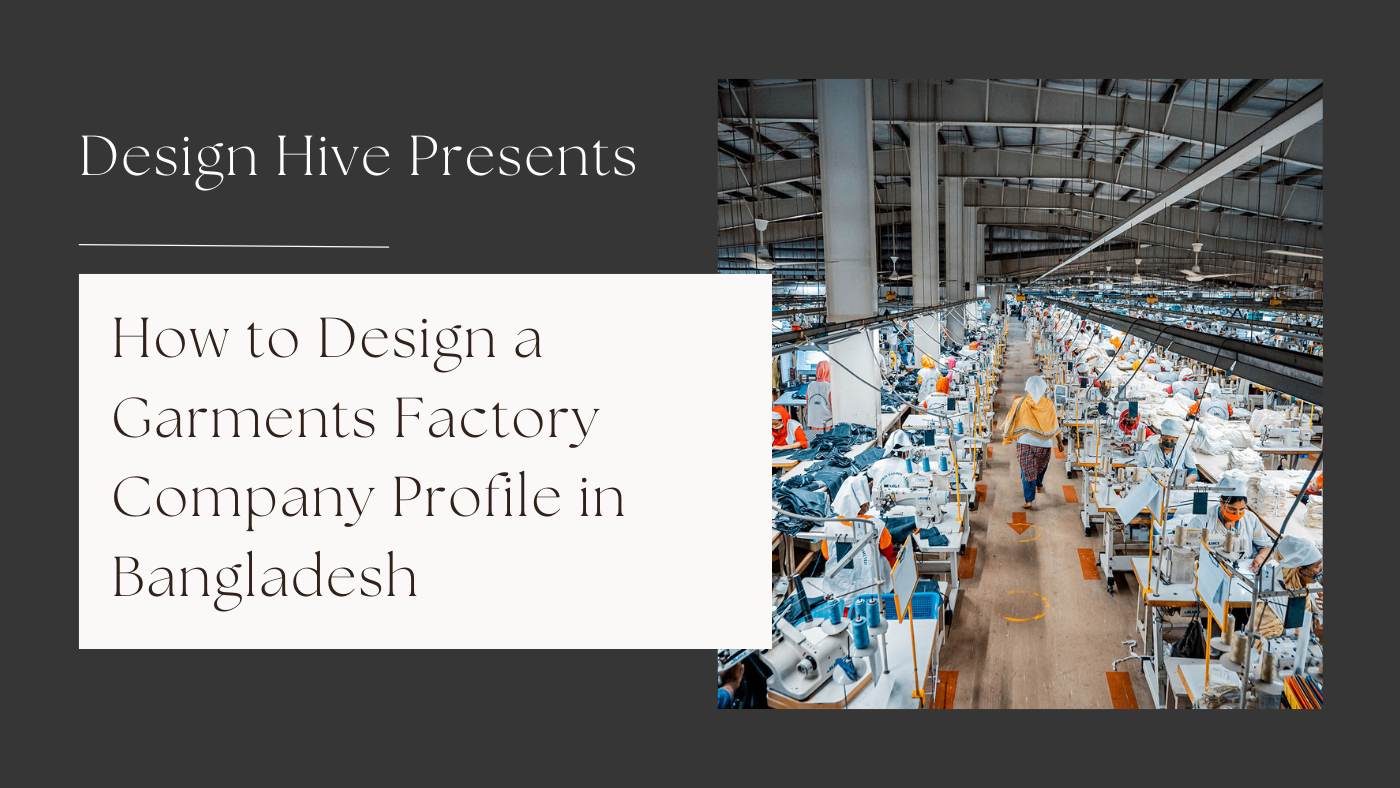
How to Design a Garments Factory Company Profile That Wins International Buyers
Bangladesh is the second largest garments exporter in the world. With over 4,000 active factories and exports projected to exceed USD 45 billion in the 2025–2026 fiscal year, the competition for international buyer relationships has never been more intense.
In this environment, your factory’s company profile is not a formality — it is a front-line business development tool. It is the document that a sourcing manager in Germany, a compliance officer in the United States, or a buying agent in Hong Kong will read before deciding whether to schedule a factory visit, place a trial order, or add your facility to their approved vendor list.
A weak company profile means your factory is invisible to buyers it could have won. A professional, well-structured garments factory company profile keeps your business in the conversation — and gets you to the next stage.
At Design Hive, we have designed company profiles for garments factories, knitwear manufacturers, woven fabric producers, and buying houses across Bangladesh. This guide shares exactly what we have learned about what works, what international buyers actually look for, and how to structure a garments factory profile that performs.
Why International Buyers Care About Your Company Profile
International buyers — whether they are fast fashion retailers, premium apparel brands, or sourcing agents — receive hundreds of factory inquiries. Before they invest time in a factory visit or compliance audit, they need to form a preliminary judgment about whether your facility is worth investigating further.
Your company profile is the primary tool they use to make that judgment.
Specifically, buyers are trying to answer five questions from your company profile:
- Can this factory produce what we need? (product capability, capacity, machinery)
- Is this factory compliant? (certifications, audit history, labour and environmental standards)
- Is this factory financially and operationally stable? (history, scale, client base)
- Are they trustworthy? (leadership, track record, existing client relationships)
- Can we communicate with them effectively? (language capability, professionalism of materials)
Every section of a well-designed garments factory company profile is answering one or more of these five questions. If your current profile does not address all five clearly, it is likely losing you buyer opportunities.
The Essential Sections of a Garments Factory Company Profile
1. Cover Page — Make the First Impression Count
The cover page is your factory’s visual handshake with the buyer. It should immediately communicate that you are a professional, well-organised operation.
Must include:
- Factory name and logo in high resolution
- A striking photograph — ideally a wide-angle factory floor shot showing organized production lines, modern machinery, and a clean environment
- Your product specialization (e.g., “Premium Knitwear Manufacturer” or “Woven Garments Exporter”)
- Year of establishment and a brief tagline
What to avoid: Low-resolution images, stock photography of factories that are clearly not yours, cluttered layouts, or missing logo files. Buyers notice immediately when a cover uses generic imagery.
2. Company Overview
A concise introduction that answers the most basic buyer question: who are you?
Must include:
- Full registered company name
- Year of establishment
- Location (industrial zone, district)
- Total floor area and number of buildings
- Total workforce (breakdown by production and non-production staff)
- Current production capacity (units per day or per month)
- Primary export markets and countries
Example format: “[Factory Name] is a BSCI-certified readymade garments manufacturer established in [year], located in [industrial zone], Dhaka, Bangladesh. Operating across [X] sq. ft. of production floor space with [X] workers and [X] production lines, the factory has a daily production capacity of [X] pieces. We export primarily to [Europe/USA/Asia] and hold a current vendor relationship with [X] international brands.”
3. Chairman’s or Managing Director’s Message
Leadership credibility matters enormously to international buyers, particularly those from European markets where ethical sourcing and governance standards are closely scrutinised.
The MD or Chairman’s message should be written in a professional but personal tone — communicating commitment to quality, compliance, worker welfare, and long-term partnership.
What international buyers want to see: A leader who understands international standards, takes responsibility for operations, and is invested in building sustainable buyer relationships — not just fulfilling orders.
4. Factory History and Growth Timeline
Longevity and growth signal stability. A factory that has operated successfully for 10, 15, or 20 years has survived market cycles, compliance changes, and global disruptions — and that track record is meaningful to buyers evaluating long-term sourcing partners.
Must include:
- Year of founding and founding story
- Key expansion milestones (new floors, new product lines, new markets)
- Major certification achievements with dates
- Brand partnerships history
A visual timeline is particularly effective here — it communicates a long track record at a glance without requiring the buyer to read dense text.
5. Product Capability and Specialisation
This is the section buyers read most carefully. Be specific. Vague descriptions like “we make all kinds of garments” actually reduce buyer confidence — they suggest a factory without clear expertise or focus.
Must include:
- Specific product categories (T-shirts, polo shirts, hoodies, activewear, dress shirts, trousers, outerwear, etc.)
- Fabric specialisations (100% cotton, cotton/polyester blend, organic cotton, recycled materials, etc.)
- Buyer-specific capabilities (private label, OEM, ODM, design assistance)
- Stitch types, finishing capabilities, embroidery, printing, wash capabilities
- Minimum Order Quantity (MOQ) guidance
For premium buyers: Highlight sustainable fabric capabilities, organic certifications, and recycled materials capability — these have become decisive factors for European and North American buyers as of 2025.
6. Production Capacity and Infrastructure
Buyers need to know whether your factory can physically handle the volume they require. This section provides the operational data that allows a sourcing manager to assess capacity fit.
Must include:
- Total number of sewing lines
- Daily production capacity by product type
- Number of shifts and working hours
- Machine inventory (key machine types and quantities)
- Cutting room capacity
- Finishing and packing capacity
Present this information clearly — a table or infographic works better than dense paragraphs.
7. Certifications and Compliance
This is arguably the most important section for international buyers, and the one that is most frequently underutilised by Bangladeshi garments factories.
Bangladesh’s garments sector has made enormous strides in compliance and sustainability. As of 2026, Bangladesh has 280 LEED-certified green factories — more than any other country — and 52 of the world’s top 100 LEED-certified facilities. If your factory holds any of these credentials, they must be prominently featured.
Key certifications to showcase:
- Social compliance: BSCI, SEDEX/SMETA, WRAP, SA8000, OEKO-TEX 100
- Environmental: LEED (Platinum, Gold, Silver), GOTS (Global Organic Textile Standard)
- Quality systems: ISO 9001:2015
- Buyer-specific approvals: List any brand-specific approved vendor status
- Fire and building safety: ACCORD/RSC, Alliance (legacy), current fire and structural audit status
Critical point: Do not just list certification names. Show certificate logos, include certification numbers, and state validity dates. Buyers verify these details. A certificate logo without a number looks unverified.
8. Quality Control Process
International buyers — particularly those supplying to large retail chains — need confidence that your quality control system is systematic and documented, not ad hoc.
Must include:
- In-line quality control procedures
- End-of-line inspection process
- AQL (Acceptable Quality Level) standards followed
- Third-party inspection capabilities
- Lab testing partnerships
9. Major Clients and Buyer Relationships
For buyers evaluating whether to work with your factory, knowing that established international brands already trust you is one of the most powerful credibility signals available.
Must include:
- Client and brand logos (with permission — this is important)
- Country of origin for international clients
- Industry category of major clients (fast fashion, premium sportswear, workwear, etc.)
If you cannot display client logos: State the countries and market segments of your buyers without naming them. Even “Suppliers to major EU fashion retailers” is meaningful.
10. Worker Welfare and Social Responsibility
This section has become increasingly important for European buyers, who face growing legislative pressure around supply chain ethics and human rights due diligence (the EU Corporate Sustainability Due Diligence Directive is now in force for large companies).
Must include:
- Total workforce and gender breakdown
- Worker welfare programmes (health services, childcare, skills training, transport)
- Fair wage and grievance mechanisms
- Worker union or association status
- Environmental sustainability initiatives
11. Management Team
Introduce key leadership — the MD, GM, Factory Manager, Compliance Manager, and Head of Merchandising. Professional headshots and brief professional bios demonstrate that your factory is managed by qualified, experienced people.
12. Contact Information
Every factory profile must end with complete, verified contact information:
- Registered factory address with industrial zone
- Head office address (if different)
- Phone and WhatsApp numbers
- Email addresses (not just a generic info@ address — include a specific buyer contact)
- Website URL
- Factory GPS coordinates or Google Maps link
Common Mistakes Garments Factories Make in Their Company Profiles
Using stock photography of other factories This is far more common than it should be. International buyers notice when the factory photographs in a profile do not match the facility they subsequently visit. It immediately destroys trust.
Vague production capacity claims “High production capacity” means nothing. “18 production lines with a daily output of 25,000 pieces” is what buyers need to know.
Outdated certifications An expired BSCI certificate is worse than no BSCI certificate — it signals that compliance lapsed. Always ensure certifications displayed are current and valid.
English language errors Your company profile will be read by international buyers for whom English is either a first or second language. Grammatical errors and awkward phrasing reduce your credibility significantly. Always have the English content reviewed by a professional writer.
No buyer contact information Some factories list only a general email or phone number. Buyers prefer to know exactly who to contact — a dedicated merchandising or marketing contact name and direct number.
How Often Should a Garments Factory Update Its Company Profile?
We recommend reviewing and updating your company profile every 12 to 18 months, or immediately following:
- Achievement of a new certification
- Significant factory expansion or new product line launch
- Entry into a new export market
- Addition of a major new brand client
- Any significant compliance development
An outdated company profile that still references expired certifications or old production capacity figures is an active liability.
Final Thoughts
In Bangladesh’s intensely competitive garments sector, every operational advantage matters. A professional, well-designed company profile that clearly communicates your factory’s capabilities, compliance credentials, and track record is one of the most accessible competitive advantages available to any factory — regardless of size.
At Design Hive, we specialise in garments factory company profile design in Bangladesh. Our team understands exactly what international buyers look for, and we build every profile to address their questions clearly and credibly.
Get in touch for a free consultation — we will advise you on exactly how to position your factory for maximum buyer impact.
Design Hive Bangladesh provides professional company profile design services for garments factories, buying houses, textile manufacturers, and export-oriented businesses across Bangladesh.

Leave a Reply